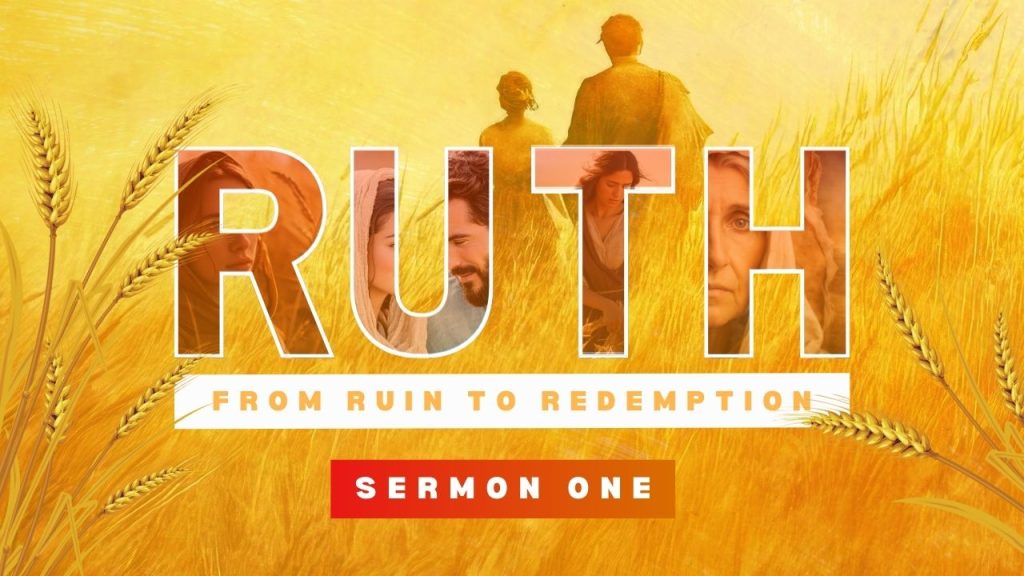
Ruth Series: Sermon One Media Kit
Ruth 1
1 Now it came to pass in the days when the judges ruled, that there was a famine in the land. And a certain man of Beth-lehem-judah went to sojourn in the country of Moab, he, and his wife, and his two sons.
2 And the name of the man was Elimelech, and the name of his wife Naomi, and the name of his two sons Mahlon ((Ma-long))and Chilion (Key-in), Ephrathites of Beth-lehem-judah. And they came into the country of Moab, and continued there.
3 And Elimelech Naomi’s husband died; and she was left, and her two sons.
4 And they took them wives of the women of Moab; the name of the one was Orpah, and the name of the other Ruth: and they dwelled there about ten years.
5 And Mahlon and Chilion died also both of them; and the woman was left of her two sons and her husband.
6 Then she arose with her daughters in law, that she might return from the country of Moab: for she had heard in the country of Moab how that the Lord had visited his people in giving them bread.
7 Wherefore she went forth out of the place where she was, and her two daughters in law with her; and they went on the way to return unto the land of Judah.
8 And Naomi said unto her two daughters in law, Go, return each to her mother’s house: the Lord deal kindly with you, as ye have dealt with the dead, and with me.
9 The Lord grant you that ye may find rest, each of you in the house of her husband. Then she kissed them; and they lifted up their voice, and wept.
10 And they said unto her, Surely we will return with thee unto thy people.
11 And Naomi said, Turn again, my daughters: why will ye go with me? are there yet any more sons in my womb, that they may be your husbands?
12 Turn again, my daughters, go your way; for I am too old to have an husband. If I should say, I have hope, if I should have an husband also to night, and should also bear sons;
13 Would ye tarry for them till they were grown? would ye stay for them from having husbands? nay, my daughters; for it grieveth me much for your sakes that the hand of the Lord is gone out against me.
14 And they lifted up their voice, and wept again: and Orpah kissed her mother in law; but Ruth clave unto her.
15 And she said, Behold, thy sister in law is gone back unto her people, and unto her gods: return thou after thy sister in law.
16 And Ruth said, Intreat me not to leave thee, or to return from following after thee: for whither thou goest, I will go; and where thou lodgest, I will lodge: thy people shall be my people, and thy God my God:
17 Where thou diest, will I die, and there will I be buried: the Lord do so to me, and more also, if ought but death part thee and me.
18 When she saw that she was stedfastly minded to go with her, then she left speaking unto her.
19 So they two went until they came to Beth-lehem. And it came to pass, when they were come to Beth-lehem, that all the city was moved about them, and they said, Is this Naomi?
20 And she said unto them, Call me not Naomi, call me Mara: for the Almighty hath dealt very bitterly with me.
21 I went out full, and the Lord hath brought me home again empty: why then call ye me Naomi, seeing the Lord hath testified against me, and the Almighty hath afflicted me?
22 So Naomi returned, and Ruth the Moabitess, her daughter in law, with her, which returned out of the country of Moab: and they came to Beth-lehem in the beginning of barley harvest.

Life doesn’t always go as planned.
Some of us thought we’d be further ahead by now, with less heartache and more answers.
But just because we don’t understand what’s happening doesn’t mean that God is absent.
In the book of Ruth, we see how God can take brokenness and turn it into blessing.
Note: The book of Ruth is one of the most beautiful and profound narratives in the Bible
? Overview of the Book of Ruth
? Title: Ruth
•Named after the central character, a Moabite woman who becomes part of God’s redemptive plan.
•It’s one of only two books in the Bible named after women (the other is Esther).
⸻
✍️ Authorship & Date
•Traditionally attributed to Samuel, but the text itself doesn’t name the author.
•Likely written during or after the Davidic monarchy (10th century BC), as David is mentioned in the genealogy at the end.
⸻
?️ Historical Setting
•Takes place during the time of the Judges (Ruth 1:1), a period of political instability and moral decline (approx. 1200–1000 BC).
•The story stands out as one of faithfulness and hope amid national chaos.
⸻
? Structure of the Book (4 Chapters)
1.Chapter 1 – Ruth’s loyalty and Naomi’s loss
2.Chapter 2 – Ruth meets Boaz while gleaning
3.Chapter 3 – Ruth approaches Boaz at the threshing floor
4.Chapter 4 – Boaz redeems Ruth, and the genealogy to David is revealed
⸻
? Key Themes
•Loyalty – Ruth’s commitment to Naomi: “Where you go, I will go…” (Ruth 1:16)
•Redemption – Boaz acts as a kinsman-redeemer (go’el), foreshadowing Christ.
•Providence – God’s unseen hand working through ordinary circumstances.
•Inclusion – A Gentile woman is brought into the covenant family.
•Lineage of Christ – Ruth becomes the great-grandmother of King David, and part of Jesus’ genealogy (Matthew 1:5).
⸻
? Key Verses
•Ruth 1:16–17 – Ruth’s vow of loyalty to Naomi
•Ruth 2:12 – Boaz blesses Ruth for seeking refuge under God’s wings
•Ruth 4:14–15 – Naomi is restored through Ruth and Obed
•Matthew 1:5 – Ruth listed in the genealogy of Jesus
⸻
? Genealogy Connection
•Ruth marries Boaz
•They have Obed
•Obed becomes the father of Jesse
•Jesse becomes the father of David
•Therefore, Ruth is part of the Messianic line.
⸻
? Unique Features
•Strong female lead with virtue and courage
•Highlights the power of choice and character
•A story of hope rising out of loss
•Sets the foundation for the Davidic covenant
⸻
✝️ Christ in the Book of Ruth
•Boaz is a type of Christ:
•Willing Redeemer
•Related by blood
•Able to pay the price
•Does so willingly and lovingly
Note: It’s filled with themes of providence, faithfulness, trust and redemption.
Note: The book doesn’t have a author by name. We know that the Spirit of God is the author of the Bible.
Note: As far as a human penmen. Some have credited the writing to Samuel.
Note: The book was written during the time of the judges.
Note: During this time there was spiritual decline and moral corruptness.
Judges 21:25
25 In those days there was no king in Israel: every man did that which was right in his own eyes.
Note: It was a period when Israel had no centralized leadership. Instead, God raised up judges.
1350–1050 BC was the time of the judges.
The first King was Saul who began at Approx. 1050–1010 BC.
King David becomes king at about 1010–970 BC
Note: The story opens in Bethlehem, a place that means “house of bread”
Note: Yet there was a famine in the land.
Note: There isn’t any bread.
Note: This isn’t just a physical famine, but a spiritual one.
Note: Israel had drifted from God.
Note: I do believe that we are living in our spiritual famine in our country today. This was a country where churches were full, and people were excited to hear from God. The busyness of life could not take away from their desire to know God.
Note: Now, church is the place people go when there is nothing else on the schedule.
Note: There was a time when everyone knew the stories of the Bible. You could talk to visitor children in Sunday School or at VBS, and they all heard the stories of David, Jonah and Mosses.
Note: But that isn’t the case today.
Note: Many kids in our country have no Biblical understanding at all.
Note: We have turned away from the God on whom our country was built.
Note: A Spiritual famine is all around us.
Note: There was no bread in Bethlehem.
Note: We are introduced to a man, Elimelech was his name. He was from the tribe of Judah.
Note: His wife’s name was Naomi.
Note: They had two sons.
Note: The first son’s name was Mahlon
Note: The second son’s name is Chilion
Note: The passage of Scripture opens with a big decision that’s made by Elimelech.